Habits
“You don’t rise to the level of your goals—you fall to the level of your habits.”
– James Clear, Atomic Habits
Overview
Habits are automatic behaviors we perform with little or no conscious thought, such as brushing our teeth, tapping our nails, or taking the same route to work.
They are formed through repetition and become hardwired patterns in the brain. This automation helps conserve mental energy and allows us to focus on more complex decisions.
Habits can be either positive or negative. Examples of positive habits include activities like showering, brushing teeth, and saying thank you. In contrast, negative habits include biting your nails, not being concerned about others, not listening, excessive alcohol consumption, eating without thought, and raising your voice during conversations.
They are formed over time based on several factors. But I found that for me, the most important consideration was the loop that happens related to habits. One author on the subject, Charles Duhigg, author of The Power of Habit, describes a “habit loop” consisting of three components:
- Cue: A trigger that initiates the behavior (e.g., waking up).
- Routine: The behavior itself (e.g., checking social media).
- Reward: The benefit you get (e.g., a hit of dopamine from a notification).
If we can understand this loop, we will be able to change our habits and meet our goals.
Habits are the foundation of your daily life. By consciously shaping them, you can design a lifestyle that aligns with your goals, values, and aspirations.
How Long Does It Take to Form a New Habit?
The popular “21 days” idea is a myth. Research from University College London suggests it takes, on average, 66 days to form a new habit, but this can range from 18 to 254 days depending on the complexity of the behavior and individual factors.
Habits are grouped into three categories:
- Motor Habits: Physical routines such as exercising, posture, or even how you perform your work (typing, organizing, etc.).
- Cognitive Habits: Patterns of thinking, like how you respond to stress or how you process feedback.
- Emotional Habits: Repeated emotional responses, such as reacting with anger, anxiety, or optimism in specific situations.
Each of these types can be either positive (e.g., regular workouts, praying, giving, sleeping, writing, creative writing, journaling) or negative (e.g., procrastination, binge drinking /intoxication, or emotional eating).
How are habits identified?
By observing, recording your patterns and routines, you will be able to identify your habits, and you can label them as positive or negative. Then, you’ll be able to identify your behavior.
Homework
Start a simple journal.
Write what happens when you wake, when you eat, when you drink, when you yell, when you freeze, when you exercise, when you have short patience, when you feel frustration.
- Learn to be self-aware.
- What are your routines?
- Identify your triggers.
- Recognize your rewards systems.
- Identify SPECIFICALLY what you want to change.
Why you should want to change your habits
Here are a few reasons why you may want to change your habits.
- Better health: Physical habits influence sleep, diet, and fitness.
- Improved mental well-being: Cognitive and emotional habits shape your resilience and outlook.
- Greater productivity: Replacing unhelpful routines with goal-aligned behaviors leads to efficiency.
- Personal growth: Habits define your identity, change them, and you change who you are.
How to Change your habits
If you want to make changes that improve your lives and to change a habit, don’t try to eliminate it; don’t punish yourself and “kill it.” Instead, replace the habit with a new one, creating a routine while keeping the same cue and reward. This is more effective than attempting to erase the behavior from scratch.
To succeed identify your cue (time, place, emotion, preceding action).
Example:
Old Habit: Feeling stressed (cue) → Eating junk food (routine) → Feeling comforted (reward)
New Habit: Feeling stressed (cue) → Going for a short walk (routine) → Feeling comforted (reward)
Test a replacement routine.
- Reward yourself consistently.
- Track your progress with journals or apps.
Homework
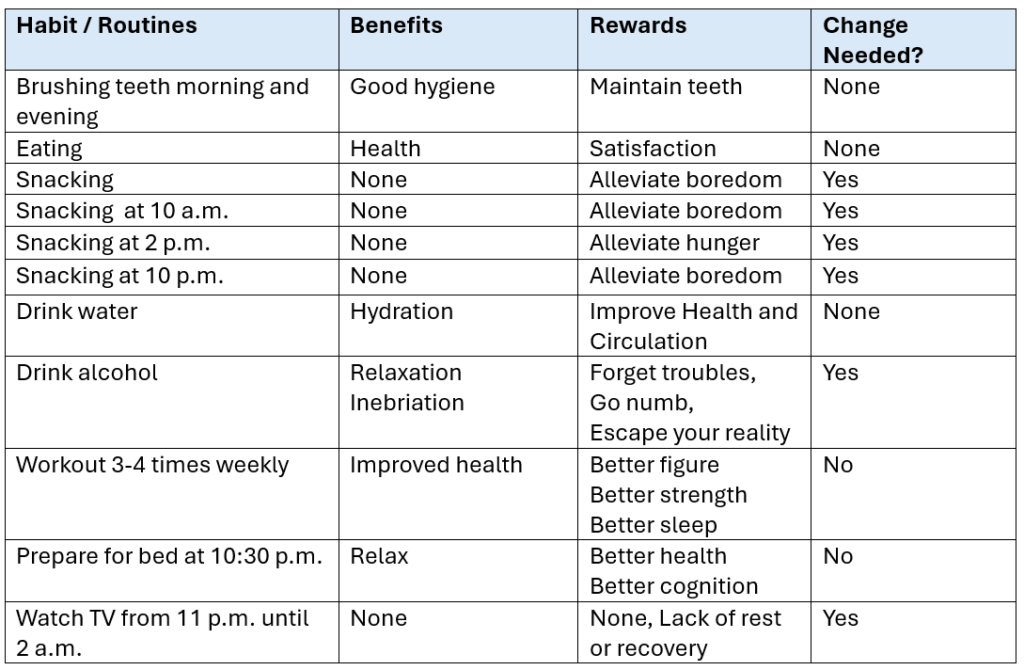
- Create a table with the following four (4) columns: Habit/routines, Benefits, Reward for the Systems, Changes Needed?)
- Identify your habits/routines, triggers, and reward systems such as:
-
- When you wake, when you eat, when you drink, when you yell, when you freeze, when you exercise, when you have short patience, when you feel frustration.
- When you plan your meals, how much do you snack while eating your meal.
- When you shower, brush your teeth, etc.
- When you prepare for bed/sleep.
Reflections
-
-
- What did you learn from a technical perspective?
- What did you learn about yourself and your routines?
- What will you do with this new information?
-
Final Thoughts
-
-
- Start small, stay consistent, and watch for change; with intention, you will change.
- Consistency, not perfection, is key.
- Missing a day doesn’t reset the process, but staying off track for weeks will.
-
Resources
Watch these videos and read these articles to learn how to develop positive habits and get rid of negative habits.
-
-
- Atomic Habits: How to Get 1% Better Every Day
- Building & Changing Habits with James Clear of Atomic Habits
- Why Bad Habits Stick (And How to Finally Break Free)
- Change a Bad Habit in 40 Days
- 40 Days to Go: What Will You Do?
- Change Your Brain
- How to Change Your Habits, Fast (3 Science-Based Strategies)
-